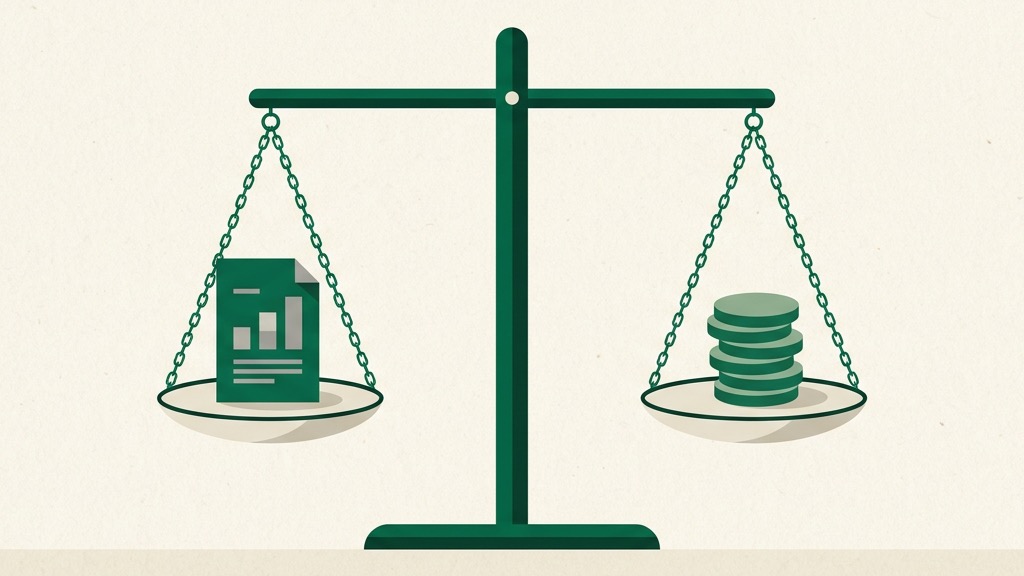
What you give up with a free plagiarism checker is mostly capacity and convenience, not detection quality. What you give up with some free checkers is your text, quietly, in the privacy policy. Those are two different trades, and the entire free-versus-paid question comes down to keeping them separate.
I test these tools for a living, and this is not a tool list. It is the structural comparison: what a paid tier can genuinely buy, what it cannot buy at any price, and the two questions that decide which side of the line you belong on. Our own tool is free, so read knowing that, and knowing I will tell you its limits as plainly as anyone's.
What free actually costs: the honest version
Scanning text against an index costs compute, so free tools ration it. The rationing shows up as word caps per scan, ours is 2,000, fewer scans per day, one document at a time, and no way to plug the checker into anything else. For a student checking an essay, the rationing barely registers: split a long paper into two scans and you are done. For an agency checking forty drafts a week, the rationing is the product, and that is deliberate.
The second cost is the one that does not appear on any pricing page. Some free checkers pay for themselves with your submission: retaining it, using it to improve their systems, or licensing data derived from it, with the details buried where nobody reads. I went through ten free checkers' privacy policies line by line, and the range ran from clear zero-retention promises to policies that quietly claim training rights over everything you paste. Before any free tool touches a client draft or an unsubmitted thesis, that is the page to read, and the trade to refuse.
What paid genuinely buys
Strip the marketing and paid tiers sell three real things. Capacity: bigger caps or none, batch scanning, more scans per day. Workflow: team seats, shared history, an API, integration with the systems a class or an agency already runs. And coverage of licensed content: the corpora that matter beyond the open web are licensed from publishers, licensing costs money, and subscription products are how that cost gets paid. Turnitin's publisher partnerships are the visible example of how much of the scholarly record sits behind agreements rather than crawls.
All three are legitimate purchases when the shoe fits. None of them changes the fundamental mechanics: matching your text against an index and showing you what overlapped. A paid scan of a clean essay is a more comfortable way to learn what the free scan would have told you.
What no amount of money buys
Two things stay off the market entirely, and knowing them saves you from the upsells that imply otherwise.
Nobody sells access to Turnitin's student paper repository. It is the largest collection of student writing in existence, it is the tier of its database doing the most work on student submissions, and no outside product, free or paid, can search it. A tool claiming to predict your Turnitin score is describing a product that cannot exist.
And no tool, at any price, sells certainty. Every checker's number is a function of its own corpus and filters, which is why the same paper scores differently everywhere it is scanned. Paying more buys a bigger corpus, not the corpus, and a clean report from any tool remains a statement about what that tool searched, nothing stronger.
The middle tier everyone forgets they already own
Before paying anyone, ask two places whether you already have access. Your library: institutional subscriptions to research and writing tools are common, they are paid for out of fees you have already handed over, and the license list sits on a library page nobody visits. And your instructor: where an assignment runs through a checker anyway, some courses are set up to allow a draft check, and the worst case for asking is a no plus thirty seconds of looking diligent.
The same logic applies inside companies. Agencies that pay for an editorial toolchain often have a checker bundled somewhere in it, unused, because the person who signed the contract and the person pasting drafts into a free site at midnight have never spoken. Audit what you own before you size what you lack.
Reading a pricing page like a tester
When you do go shopping, the pricing page tells you more than the feature grid if you read it adversarially. Find the cap fine print first: a "unlimited" that resolves to a fair-use clause, a per-page price that assumes 250-word pages, a monthly quota that resets on a date rather than a rolling window. Then find the retention policy from the pricing page in one click or assume the answer is bad. Then look for what the deep search actually names: a corpus described only with adjectives, billions of pages, premium sources, is a corpus they will not specify, and you are buying the adjective.
And notice when the page is selling fear instead of capacity. Countdown timers, deadline-week discounts, and screenshots of alarming red scores are aimed at students at 2 a.m., and a product confident in its scanning does not need your panic. The tools worth paying for sell throughput to people with a throughput problem, in daylight.
The two questions that decide it
How much text, how often? One essay before each deadline: free covers it completely, and the leftover budget buys a better use, a citation manager, a coffee while you do the closed-book rewrite. Recurring volume, a team, or anything that wants automation: pay, because the rationing you are working around costs more in time than the subscription does in money.
How sensitive is the text? A published blog post is already public, scan it anywhere. An unsubmitted thesis, a client deliverable under NDA, anything embargoed: the checker's data handling outranks its price entirely, and a paid tool with a retention policy you have not read is worse than a free one with a deletion promise you have. Price and privacy are independent axes. Check them independently.
Where we sit in this, stated plainly
PlagiarismCheck.io is the free side of the trade with the second cost removed: no account, text deleted after the scan, source links on every match, and scan settings that let you exclude quotes, bibliographies, and your own domain. The rationing is real and I will not pretend otherwise, 2,000 words per scan means a dissertation goes through in pieces, and there is no API, no batch mode, no team dashboard. If those absences read as dealbreakers, you are the paid tier's customer, and that is a fine thing to be.
The mistake worth avoiding is buying capacity you do not have a volume problem for, or donating a manuscript's training rights to save nine dollars. Free versus paid is not a quality war with a winner. It is a sizing question with a privacy question stapled to it, and now you have both questions in hand.