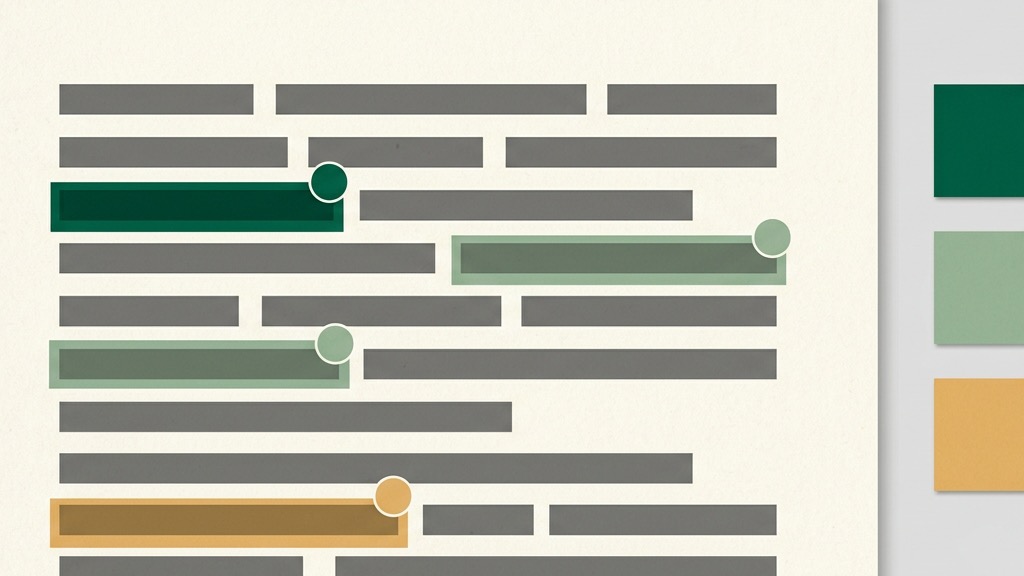
Nowhere in a Turnitin similarity report does the word plagiarism appear as a verdict. The report says one thing, many times, in color: this text matches that source. Whether any match is a problem is a judgment the report is structurally incapable of making, which means reading it is a skill, and the students who panic at a number mostly have not been taught the skill.
This is the line-by-line method: what each layer of the report is, in the order you should read them, and the three questions that sort every highlighted passage into fine or fix.
Layer one: the score, and what the color band is actually telling you
The percentage at the top is the share of your text that matched anything, anywhere in the databases searched. It arrives wearing a color, and Turnitin's own documentation lays the bands out plainly: blue for no matching text, green from 1 to 24 percent, yellow from 25 to 49, orange from 50 to 74, red from 75 to 100.
Here is what the band measures: quantity. Here is what it does not measure: anything else. A green 20 percent can hide a stolen page; a yellow 30 can be a heavily quoted literature review in perfect order. The color is a sorting convenience for instructors facing a stack of reports, not a grade, so read it once, note it, and move down a layer, because everything that matters is below.
Layer two: the source list, two ways
The report's side panel gives you the matches in two views. The overview groups them and ranks sources from largest contribution to smallest, which answers the first diagnostic question: is my score one big match or forty tiny ones? One source at 18 percent is a very different situation from thirty sources under 1 percent each, even at the same total.
The all-sources view lists every source individually, and this is where the detective work happens. Each match in your text carries a number and a color tied to its source card, and arrows on the card hop you between every place that source matched. Follow one source through your whole paper before moving to the next. A source that surfaces in five scattered places is telling you something different from one that owns a single paragraph.
Layer three: the match groups, where the newer report does sorting for you
Turnitin's newer report experience adds a grouping that older walkthroughs do not mention: matches are divided into four categories by whether each one carries a citation and quotation marks. The group without either is the one to take seriously, because it is the report's best guess at unattributed borrowing.
Treat that group as your work list, but audit it rather than trusting it, in both directions. The detection of quotation marks and citations is mechanical, and mechanical detection misses things: block quotes have no quotation marks by design, and properly cited text lands in the wrong pile for reasons that are formatting, not honesty. The sorting accelerates your reading. It does not replace it.
The three questions that sort every highlight
Now go highlight by highlight, asking each one, in order.
Is it attributed? A match inside quotation marks with a citation, or in your reference list, is the system working as designed. Confirm the attribution is intact, then move on without rewriting anything.
Is it structural? Common phrases, technical terms, the assignment question, boilerplate of your field. A match of "randomized controlled trial of" is noise. So is your name and institution on the cover page. Noise needs no action, and rewriting noise makes papers worse.
Is it in my own voice sections? This is the question with consequences. A run of matched words inside a paragraph you present as your own analysis or paraphrase is the thing the report exists to find. For each of those, open the source, compare honestly, and fix what needs fixing: real quotation marks if you want the wording, or a genuine closed-book rewrite if you do not. Length matters here: an eight-word match in an analysis paragraph deserves attention, a three-word match almost never does.
A worked example: one report, four sources
Here is the method running on a constructed but typical case. The paper comes back yellow at 26 percent, which reads as alarming for about ten seconds. The overview shows four sources: one at 11 percent, one at 8, one at 5, one at 2.
Follow each in turn. The 8 percent source maps entirely onto three block quotes, each introduced, each cited: attributed, done, no action. The 5 percent is the reference list matching the same works everyone cites: structural, done. The 2 percent is confetti, four words here, five there, across common phrasing: noise, done.
The 11 percent source is one webpage, and the arrows walk you through five separate matches, all landing inside the literature review, in paragraphs written as the student's own summary. Open the source and the story is obvious: the summary tracked one article's wording too closely, paragraph after paragraph. That is the finding. Not 26 percent, but one source, five passages, one afternoon of closed-book rewriting.
The report seemed to say a quarter of the paper is suspect. Read properly, it said 11 percent of it leans on a single page, and everything else is bookkeeping. That gap between the headline and the reading is the whole skill.
The flags tab, briefly
Newer reports carry an integrity flags panel that highlights manipulated text, swapped lookalike characters and hidden white text being the headline cases. If you never touched such tricks and a flag appears anyway, do not ignore it: something in your file, often surviving artifacts of a paste from another format, produced it, and the person you want explaining it first is you, to your instructor, rather than the other way around.
What the student view cannot show you
One asymmetry to hold onto: any exclusions you apply in your own view, filtering quotes or bibliography to see a cleaner number, are temporary and do not change the official score your instructor sees. Their report, with their configured filters, is the real one. So if your practice reading turns up a score inflated by quotes and references, the productive move is not more filtering on your side, it is one email asking which exclusions the assignment applies.
Build the reading skill before the stakes arrive
Everything above is a transferable skill, and you can practice it before submission on a report you control. Scanning a draft with PlagiarismCheck.io gives you the same reading exercise, exact matches highlighted in red and similar text in yellow, each with a link to its source, free and without an account. The color vocabulary differs, the discipline is identical: ignore the total, follow each source, ask the three questions, fix only what fails them.
Read this way, a similarity report stops being a verdict you receive and becomes a document you interrogate. The number at the top is the least interesting thing on the page. The interesting thing is which of your paragraphs have company, and now you know how to find out.