A grad student emailed me in April, half panicked. Her advisor's syllabus said "undisclosed AI use will be treated as academic dishonesty," and she'd asked ChatGPT to tighten a rough paragraph in her lit review before she submitted it. She hadn't copied a single sentence from another author. Was she a plagiarist?
I've fielded some version of that question a dozen times this year, from students, from freelance writers turning in client work, from a high schooler whose teacher ran her essay through three different detectors and got three different answers. The honest answer is that "using ChatGPT" and "plagiarism" aren't the same thing, but they overlap in ways most syllabi never spell out clearly.
Plagiarism was never about the tool, it's about the claim
There is one more definition of plagiarism that has remained the same: putting the words and ideas of someone else in your own authorial voice, who then receives no credit. That's not a reference to AI at all, but to the claim you're effectively making when you submit a piece of writing: I created this, it sounds like me, it's what I think.
Where ChatGPT complicates things is authorship. If you paste in a prompt and submit the output as your essay, you're not claiming false authorship of someone else's specific sentences, since no single person wrote those words. But you are claiming authorship of thinking you didn't do. Most academic integrity offices now treat that as its own category of misconduct, separate from traditional plagiarism but judged just as seriously.
The University of Missouri's Office of Academic Integrity clarifies: "In and of itself, the use of AI tools is not cheating; representing the work of an AI tool as your own original work and submitting it without attribution can be considered cheating." The program did not cheat. The uncredited submission did.
The real dividing line in 2026: disclosure, not detection
Two years ago, most institutions had a single blanket rule: no AI, full stop. That's mostly gone now. What I see instead, reading through a stack of syllabi for this piece, is a patchwork where the same university allows AI brainstorming in one course and bans it entirely in another, sometimes with different rules from professor to professor in the same department.
The new trend that has emerged after the blanket ban is disclosure. If your professor's policy is that AI is okay with attribution and you use it but do not provide attribution, then it's the failure to provide attribution, not the use of AI itself. If a professor's class explicitly disallows using any AI at all and you use ChatGPT to generate even one paragraph, then that is a violation regardless of how you disclose. Read the actual line in the syllabus, not the feel of "my professor seems chill about this."
When a policy does allow disclosed AI help, here's roughly where I've seen the line drawn across different departments:
- Usually fine, even undisclosed: using AI to check grammar, ask "does this sentence make sense," or generate a study outline you rewrite entirely yourself.
- Fine only if disclosed: using AI to draft a paragraph, restructure an argument, or generate a first pass you then substantially rewrote.
- Treated as misconduct in most policies: submitting AI output with light edits as your own analysis, or having AI generate citations or sources you never actually read.
How to cite ChatGPT if your class actually requires it
If your syllabus permits AI with attribution, both major style guides now have a real answer, though they disagree with each other in a way that trips people up.
Here's the annoying part. MLA doesn't want you treating ChatGPT like it co-wrote your paper, it just wants it treated as a source, sort of like citing a website. So you write out your exact prompt in quotes, tack on the word prompt, then the platform name, the version, the company, and the date. Honestly it ends up reading less like English and more like a barcode, but that's genuinely what MLA asks for:
MLA
"Summarize the main argument of chapter 3" prompt. ChatGPT, 13 Feb. version, OpenAI, 8 Mar. 2026, chat.openai.com/chat.
APA goes the opposite direction and gives the AI company actual author credit, formatting it like a piece of software. You include your exact prompt in your own text or an appendix, and the reference entry looks like this:
APA
OpenAI. (2026). ChatGPT (Mar 14 version) [Large language model]. https://chat.openai.com/chat
Neither style guide says you're plagiarizing by using AI. Both say you're misrepresenting your work if you don't cite it when required. That distinction is the whole article, really.
Why an AI detector score isn't proof of anything by itself
Here's the part that makes students genuinely anxious, and rightly so. Turnitin has published its own numbers: for documents where more than 20% reads as AI-written, they claim a document-level false positive rate under 1%, but at the sentence level that climbs to roughly 4%, meaning 4 out of every 100 flagged sentences were actually written by a human.
However, outside research paints a more grim picture. A Stanford-led study reported that AI detectors, including Turnitin, misclassified writing by non-native English speakers as AI-generated 60% of the time on average, a false positive rate over 60%. An independent review by Weber-Wulff and colleagues found that none of the 14 prominent detectors tested cleared 80% accuracy overall.
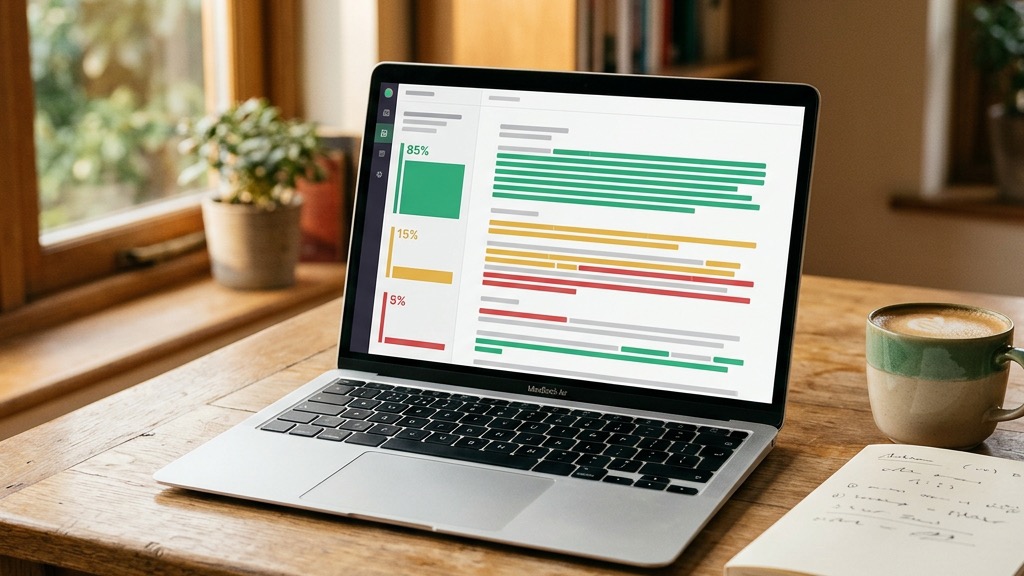
This is why a good policy uses a detector flag simply as a prompt to discuss, not as a solution. If you're fouled up by a score, see what happens if you ask for evidence beyond it. And if you do your own work and want to check it, feed it into a system that shows the actual matching sources rather than an opaque single number. That's the sort of difference we offer between our plagiarism checker and plain AI-detection: our highlights are red and yellow, connected to real URLs, to show you just what caused the match.
It's not just students asking this
I get the same question from freelance writers almost as often, just with different stakes. A content client's contract usually says something like "100% original, human-written work," written back before anyone anticipated ChatGPT drafts showing up in a Google Doc. Nobody calls that clause plagiarism if you breach it, they call it breach of contract, but the underlying trust problem is identical: the client believed they were paying for your judgment and your sentences, and found out otherwise.
I've seen writers handle this two honest ways. Some disclose upfront that they use AI for a first pass and then edit heavily, and negotiate that into the rate. Others just do the actual writing themselves and use AI the way you'd use a thesaurus, for a synonym or a smoother transition, nothing that changes who did the thinking. Both are fine. What isn't fine, and what gets writers dropped by agencies fast, is submitting a barely-touched AI draft under a contract that promised otherwise and hoping nobody checks.
A five-minute check before you submit anything AI-assisted
- Reread your syllabus's actual AI policy line, not your memory of a conversation about it.
- If AI use is disclosed or cited, make sure the citation is actually in the document, not just in your head.
- Rewrite anything AI drafted enough that the reasoning is demonstrably yours, not just reworded. If a passage still comes back flagged after you've tried, a tool built for rewriting matched text will catch phrasing you missed.
- Run the final draft through a checker that shows source-level matches, so a stray uncited quote doesn't surprise you later.
- If you're unsure whether a specific use crosses the line, email the professor before submitting, not after.
I never did find out if that grad student's paper got flagged. Turns out she wasn't cheating though, at least not under her own professor's rules. She'd just had ChatGPT smooth out a paragraph she'd written herself, and once she actually sat down and read her advisor's syllabus, something she'd skipped in the panic, it allowed exactly that kind of edit. No citation required. The tool was never the problem. Nobody tells you upfront what these policies actually say, so you assume the worst. Go read yours before you assume the same, and run your draft through a checker before someone else's flags it for you.