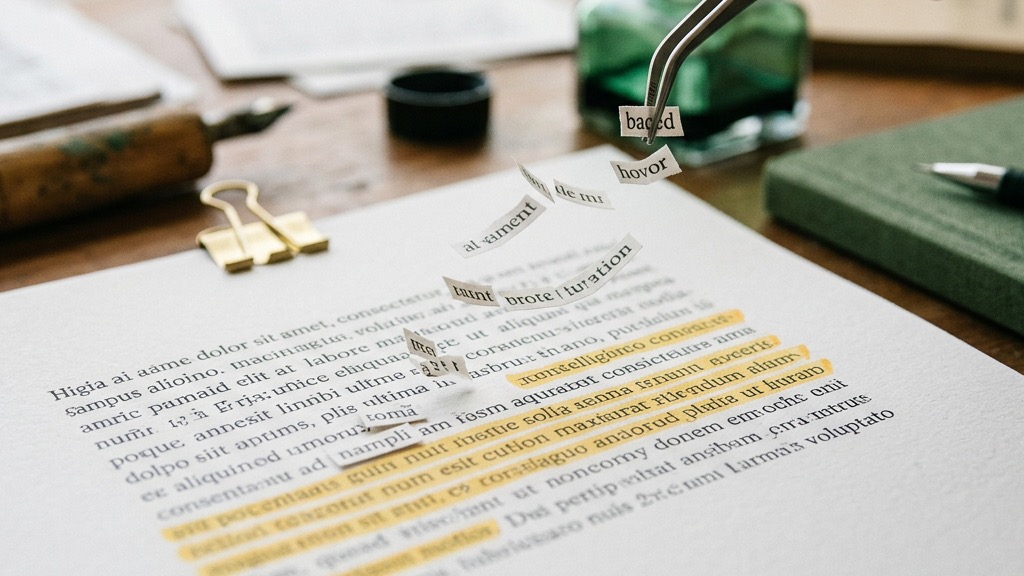
It depends completely on how the paraphrasing got done. A passage you genuinely rewrote from understanding is usually invisible to a checker. A passage you produced by swapping words while staring at the source is usually caught. The tool is not hunting for paraphrasing as a category. It is measuring how much of the original made it through.
That distinction is the whole answer, and it explains every confusing result students report: why one reworded paragraph sails through and another lights up, why a synonym tool gets flagged, and why real rewriting does not.
Two different detection systems, often confused
A modern checker runs two separate machines, and people blur them into one question.
Text matching hunts for shared runs of words against an index. It is the original plagiarism check, and it only catches a paraphrase when enough consecutive words survived from the source. The mechanics here are worth knowing in full, because they pin down the limits exactly: it comes down to how checkers fingerprint text.
AI detection is a newer, separate estimate of whether a language model produced the writing. It does not match against a source at all. It reads statistical properties of the text itself.
These answer different questions, and a paraphrase can trip one, both, or neither. Keeping them apart is the only way the results make sense.
What text matching catches, and what it misses
Text matching works on consecutive word runs, usually five to nine words long. So the question it really asks about your paraphrase is: did any long-enough run of the original survive?
- Synonym-swapping gets caught, because it leaves the structure intact. Change every third word and you still have four-word runs matching the source between your substitutions, which is enough for the matcher.
- Reordered sentences get caught, because the individual clauses still contain original runs even if you moved them around.
- Genuine rewriting slips through, because if you rebuilt the sentence from your own understanding, no long run matches. There is nothing for the matcher to lock onto.
This is why the honest answer to "can it detect my paraphrase" is another question: did you keep the source's structure? If yes, probably. If you truly rewrote it, probably not, and that second case is not a loophole. It is what correct paraphrasing is supposed to produce.
The tools that paraphrase for you
Automated paraphrasers, the QuillBot-style rewrite tools, sit in an interesting spot, because they are better than manual synonym-swapping at breaking up word runs, which makes them harder for pure text matching to catch. That is the pitch.
The catch is the second machine. Turnitin's AI-detection updates specifically target machine-paraphrased text, looking at patterns in sentence complexity, vocabulary repetition, and semantic similarity rather than at matching runs. So a paragraph that beats the text matcher by breaking up its word runs can still register on the AI side, because the rewrite left a different kind of fingerprint.
Reported detection rates for tool-paraphrased content vary widely, roughly the mid-60s to high-90s percent depending on the study and settings, which tells you two things at once: it is caught often, and not always. Betting your grade on landing in the gap is a poor wager, and it is a different wager from the text-matching one, because now two systems have to both miss.
Why "probability" is not "proof"
Here is the part that protects you if you did the work honestly. The AI and paraphrase estimates are probability scores, not evidence. A score says the system found patterns consistent with machine generation in some portion of the text. It does not produce a source you copied, because there is no source.
That is a real and important limitation of the whole approach. A high estimate on genuinely human writing cannot be disproven the way a text match can be examined, but it also cannot be proven, which is why responsible institutions treat these scores as a prompt for a conversation rather than a finding. If your own careful rewriting ever draws a flag, that distinction is the ground you stand on.
The paraphrase that should be caught
Worth being honest about the other side. Some paraphrasing is supposed to be caught, and when the checker catches it, the checker is right.
A passage you built by keeping the source open and changing words as you went is not really your paraphrase. The structure, the order, the logic all came from the author you were reading. When text matching flags it, it is not a false positive, it is a correct catch of something with a name, and understanding why patchwriting registers as a match is what separates it from a genuine rewrite in your own head.
Why translated text is the hardest case
There is one form of paraphrasing that sits almost entirely outside text matching: translation. Take a passage in one language, render it in another, and every single word has changed, so no run of consecutive words matches the original. Pure text matching has nothing to grab.
This is not a safe loophole, and there are two reasons. First, it is still plagiarism. The ideas, the structure, the argument are all lifted, and only the surface language changed, which is the same theft of someone else's thinking any close paraphrase commits. Second, the AI-detection side is far less tied to a single language than the matcher is, and getting better across languages, so the second machine can flag what the first one sails past. No match appearing does not mean the work reads as yours to a marker who knows the field, and it is the marker, not the tool, who makes the call.
What a clean report does and does not tell you
Suppose your paraphrase passes both machines. Useful to be clear about what that proves, because students read it as a wider clearance than it is.
The matcher found no surviving runs, and the AI estimate stayed low. That is a claim about detectable overlap and statistical patterns, and it stops there. It does not say your paraphrase is accurate, or well made, or cited. You can write something no tool flags that still twists the source, still carries no citation, and is still plagiarism, because the idea under it was never yours. The checker measures one thing. The integrity of your source use is a larger thing that no tool fully covers.
How to paraphrase past every version of this
The technique that beats detection is also just the technique that produces good writing, which is the tidy part of all this.
- Read the passage until you understand it, then close the source. You cannot reproduce a structure you cannot see.
- Write the idea from your understanding, in whatever shape your own argument needs. This breaks the word runs naturally, because you are not tracing the original.
- Check against the source afterward, for accuracy, not for wording. Add quotation marks to any distinctive phrase you could not avoid reusing.
- Cite it. A perfect paraphrase with no citation is still plagiarism, because the idea is not yours even when the words are.
Do that and there is no run for the matcher and no machine fingerprint for the AI detector, not because you outsmarted anything, but because you actually rewrote it. The full method, with before-and-after examples, is in how to paraphrase without plagiarizing.
The short version
Can a checker detect paraphrasing? It can detect the kind that kept the source's bones, through text matching, and the kind a machine produced, through AI estimation. It generally cannot detect the kind you wrote from genuine understanding, because there is nothing left to detect.
Which means the reliable way to pass every check is not a better paraphrasing tool. It is to understand the source well enough that your version is actually yours, then check the draft yourself, with a checker that shows you the matches, before anyone else does.