You commissioned eight articles this month. You have time to read them, but not to read everything they were built from, and the writer knows that. The usual quality check is to paste the draft into a free checker, look at the percentage, and approve anything under some number you picked by instinct.
That check catches copy-paste. It is close to useless against the thing that actually costs agencies money, which is a competitor's article rewritten sentence by sentence into new words. Here is a process that catches both, in the order that fits an editing workflow rather than a classroom.
Decide which problem you are checking for
Three different failures get called plagiarism in commercial work, and they need three different checks.
The first is lifted text, where passages arrive verbatim from somewhere else. A plagiarism checker is built for exactly this and does it well. The second is structural copying, where the writer opened a top-ranking article and rewrote it line by line. Nothing is verbatim, so the report comes back clean, and the piece is still derivative. The third is machine-generated filler, which is a separate question with a separate tool.
On that third one, Google's position is worth knowing precisely, because it is narrower than the panic suggests. Its guidance on people-first content says that using automation, including AI generation, to produce content primarily to manipulate search rankings violates its spam policies. The method is not the problem. The intent and the quality are. Keep that check separate from the plagiarism one and do not let a single percentage stand in for both.
Check before you pay, not after you publish
This is the whole ballgame and it is a scheduling decision, not a technical one.
Once you have paid, your only remedies are awkward: chase a refund, absorb the loss, or publish something you now have doubts about. Before you pay, you have leverage and a normal revision conversation. Build the check into the acceptance step so it happens on every piece by default, rather than on the pieces that happen to make you suspicious. The ones that make you suspicious are not the risky ones. The risky ones read beautifully.
The actual procedure
- Scan the full draft in a checker, with your own domain excluded so your existing posts do not fill the report with matches against yourself.
- Open the source links behind the top three matches. Not the score, the sources. You are looking at what was matched and how much of it runs consecutively.
- Take three sentences from different sections, the more distinctive the better, and search each one in quotation marks. This catches sources the checker's index missed.
- Read the top two or three results that currently rank for the brief's target keyword, and compare their structure to the draft.
- Spot-check any statistic, quote, or study reference against the source the writer cited, or against the original if they cited a blog quoting a study.
Steps one through three take about five minutes with PlagiarismCheck.io or any checker that shows you clickable source links rather than a bare number. Step four is manual and no tool does it for you. Step five is where invented statistics get caught, and they are more common than copied paragraphs.
Reading the report without losing an afternoon
Match type matters, the total percentage mostly does not. Commercial content legitimately matches other pages all the time.
Product specifications, legal disclaimers, standard boilerplate, a quoted line from a press release, and the ordinary phrasing of a common statistic will all light up, and none of them is a problem. So will your own site, if the writer quoted your existing pages or you syndicate anywhere.
What you are hunting for is different in shape: a run of twenty or more consecutive words matching one source, several separate matches pointing at the same domain, or a matched passage sitting in the analytical part of the article rather than in a definition. One source supplying multiple scattered chunks of a draft is the strongest signal in the whole report.
The failure the checker will not catch
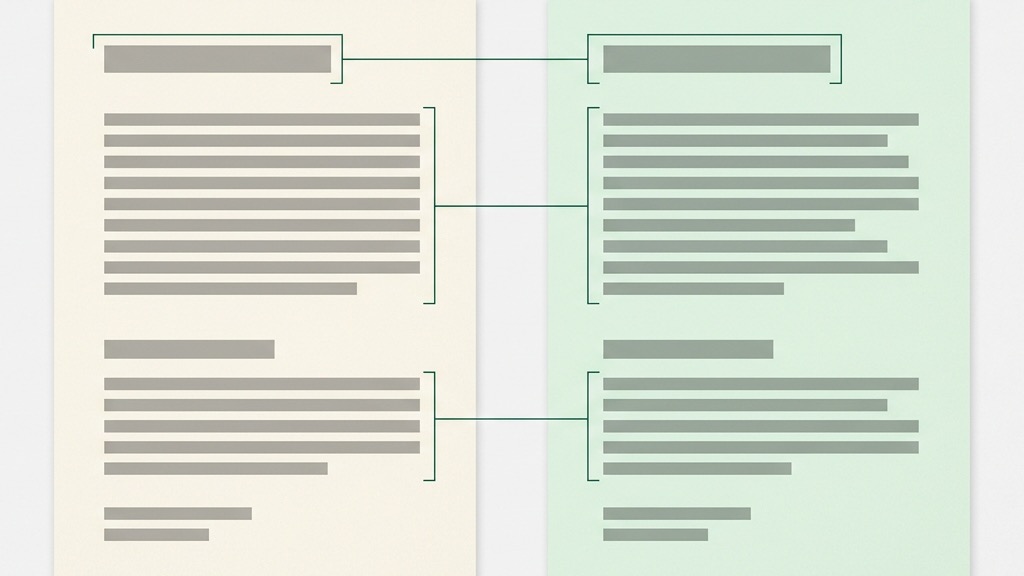
Here is the pattern that survives every automated check. The writer opens the article currently ranking first, and works through it: same sections in the same order, same examples, same statistics in the same places, every sentence reworded enough that no string matches.
Text matching is the wrong instrument for this, because there is no matching text. Some checkers flag reworded passages when the rewrite is shallow, and a genuine rewrite slips through more or less by definition. Which is why step four of the procedure exists and is manual.
What you are comparing is the skeleton. If the draft's H2s map one to one onto a competitor's H2s, and the same three examples appear in the same sequence, you are looking at a rewrite regardless of what any report says. The fix is a brief with its own angle, and a writer who can tell you where the structure came from.
Be careful what you paste into a free tool
You are handling someone else's unpublished work, sometimes under a client NDA. That makes the checker itself a vendor decision, not a throwaway one.
Several popular free checkers reserve the right to retain submitted text or use it to improve their models, and the details are in policies almost nobody opens. It is worth knowing which ones do what before you feed a client's launch content into one. Choose a tool that deletes after the scan and does not require an account, and if a client contract has confidentiality terms, check that your QA step does not quietly breach them.
The ownership check that has nothing to do with plagiarism
Original writing and writing you own are two different things, and editors conflate them constantly.
In US law, a freelancer's work is not automatically yours because you paid for it. The Copyright Office's guidance on works made for hire is that a commissioned work only qualifies when there is a written agreement saying so, and even then only if it falls into one of nine specific categories. A standalone blog post does not obviously sit in any of them. Separately, section 204(a) requires any transfer of copyright ownership to be in a signed written instrument.
The practical version: a work-for-hire clause on its own may not do what you think, which is why most publisher contracts pair it with an explicit assignment of copyright, plus a warranty that the work is original and does not infringe anyone else's rights. That warranty is the clause that gives you somewhere to stand when a check comes back bad. If real money is involved, this is a conversation for a lawyer rather than a template you found.
When a check comes back bad
Ask before you accuse. A first email that says "the check flagged these three passages against this source, can you walk me through how you drafted them" gets you a useful answer. An accusation gets you a defensive one, and you may be wrong.
The answers sort into categories fast. A writer who paraphrased too close to the source while taking notes has a fixable craft problem, and the passages can be rewritten. A writer who cannot explain where a section came from has a different problem. Decide in advance what each outcome means for the invoice, and put a kill fee in the contract so the answer is not improvised while you are annoyed.
If the piece is already live, unpublish or unindex it first and sort out the money afterwards. Leaving it up while you negotiate is the version where the original author finds it.
The same sweep runs in the other direction
Once a month, take two or three sentences from your best-performing posts and run the quoted search on them. It is the same five-minute habit pointed outward, and it is how you find out that your top article has been copied onto three aggregator sites. If it has, the removal process is a well-worn path and mostly ends with an email.
The through-line is that originality is a process step, not an instinct. Put the check at the acceptance gate, look at sources rather than scores, and keep the one manual comparison that no tool performs. PlagiarismCheck.io is free and needs no account if you want somewhere to start, and it links every match to the page it came from so step two takes seconds rather than minutes.