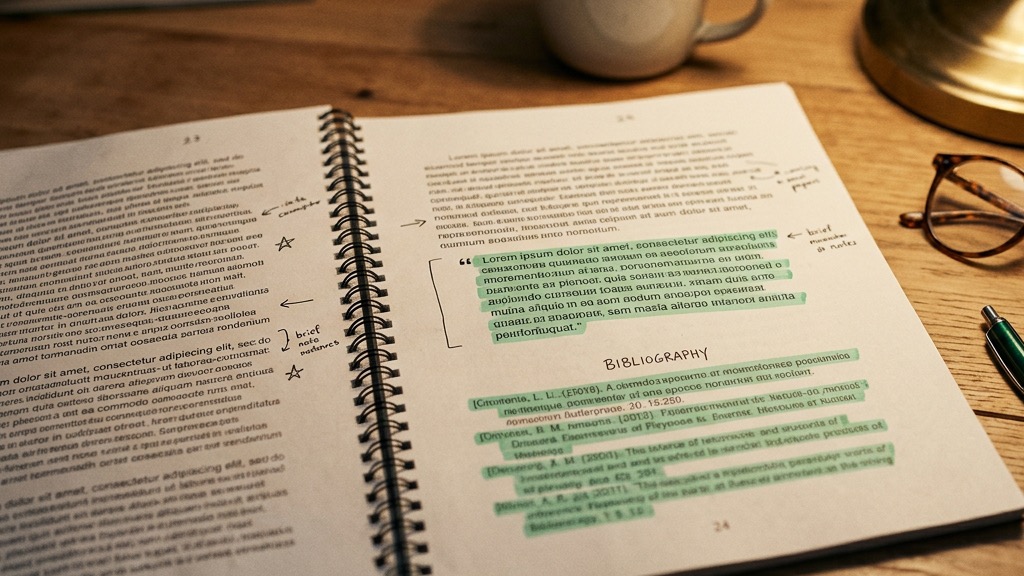
Turnitin does not know what a citation is. It matches strings of text against an index and highlights whatever it finds, then leaves every judgment about attribution to a human. Your properly quoted, properly cited passage is highlighted because highlighting matched text is the only thing the matching engine does.
Which means the highlight is not an accusation. It is the tool doing exactly what it was built to do, in front of a student who reasonably assumed a citation would protect them.
Matching happens first. Filtering happens after
The sequence matters, and almost nobody explains it. Turnitin compares your text against its index and produces a set of matches. Only then does it apply whatever exclusion filters are switched on for that assignment, subtracting some of those matches from the score.
If the filters are off, nothing gets subtracted. Your quotes, your block quotes, and your entire reference list all count toward the percentage, and they will keep counting no matter how immaculate your citation style is.
The filters that would have hidden your citations
Turnitin ships four exclusion settings that deal with cited material, described in its exclusions and filters documentation:
- Exclude bibliography. Drops text in the bibliography, works cited, or references section. For English-language papers Turnitin identifies that section automatically; other languages need recognizable opening and closing phrases, which is why the filter misses reference lists in some non-English submissions.
- Exclude quoted text. Removes "all content between quotation marks" from the report.
- Exclude cited text. Uses machine learning to spot in-line citations and leave the associated text out of the score. Being machine learning, it is a good guess rather than a guarantee.
- Exclude small matches. Filters out matches at or below a word count the instructor sets, which is what clears out stray three-word coincidences.
Here is the part students cannot do anything about directly: these are the instructor's settings, not yours. A department that leaves all four off will produce higher scores across every paper in the course, and that is a configuration choice rather than a statement about your work. There is a second wrinkle worth knowing if your instructor does agree to change something. Adjusting these settings applies to future uploads, so an already-submitted paper needs its report adjusted individually.
Why your quote wasn't excluded even with the filter on
This is the case that generates the most panicked emails, because the student did everything right and the highlight appeared anyway.
Quote exclusion is mechanical. It looks for content sitting between double quotation marks, and Cummings Graduate Institute's guidance on flagged quotations spells out the usual failures. A quote that is missing double quotation marks, uses single quotation marks, or has no in-text citation attached does not meet the conditions, so it stays in the report.
The most common victim is the block quote. Every major style guide tells you to drop the quotation marks on a long indented quote and rely on the indentation instead. Turnitin reads indentation as formatting and sees a paragraph with no quotation marks around it, so a correctly formatted APA block quote is precisely the kind of passage the quote filter cannot catch. You followed the style guide and the style guide made the software's job impossible.
Two smaller ones: quotation marks pasted in from another program sometimes arrive as characters Turnitin does not treat as quotation marks, and a quote whose citation sits several sentences later loses the pairing the filter is looking for.
Your reference list matches everyone who read the same books
A bibliography is designed to be identical across papers. That is what a citation style is for. Every entry you formatted correctly matches the same entry in every other paper citing that work, which means a thorough reference list can add several points to your score by itself.
With the bibliography filter on, this disappears. With it off, a 30-source reference list on a 2,000-word essay can be most of your similarity score, and no amount of rewriting will reduce it, because the only way to change a reference entry is to format it wrong.
The exclusions you make yourself are temporary
Students discover the filter panel in their own report view, switch on quote and bibliography exclusion, watch the score drop from 31% to 12%, and relax.
Don't. Any exclusion you apply in your own view is temporary and does not change the official score your instructor sees. It is a preview, useful for diagnosis and worthless as a defense. If the excluded score is the fair one, the fix is to ask your instructor to adjust the report, not to screenshot your own filtered view and assume the matter is settled.
The diagnostic value is real, though. Toggle the filters on and watch what the number does. If your score collapses when quotes and bibliography come out, your matching was citation mechanics all along. If it barely moves, the matching lives somewhere else in your paper, and that is where your attention belongs.
What to do when your cited text is flagged
- Open the report and look at the highlights, not the number. Sort matches by source. Cited quotes and reference entries are expected. You are hunting for anything highlighted that has no citation near it.
- Toggle the exclusion filters in your own view to see how much of your score is quotes and bibliography, remembering that this preview is not what your instructor sees.
- Check your block quotes. If an indented quote is highlighted, that is expected behavior, not an error you need to correct in the writing.
- Verify each quoted passage has both parts: the quotation marks and an in-text citation. Missing either one is the single most common cause of a flagged quote.
- Email your instructor with specifics. Not "my score is high" but "my similarity report includes my reference list and my block quotes, which brings it to 31%. Would you be able to check whether bibliography and quote exclusions are enabled for this assignment?" That question is answerable in a minute and reads as diligence.
- Fix the uncited matches. If a highlighted passage has no citation, that is the real finding buried under the noise, and it needs a citation or a rewrite regardless of what the filters are set to.
Check before it becomes official
Nearly all of this is easier to handle before submission, when a flagged passage is still an editing task rather than something on your record. If your assignment allows resubmissions, submit a draft early and read that report. If it doesn't, run the draft through an outside checker first: our free plagiarism checker shows exact matches in red and reworded ones in yellow with the source link attached, so you can see in a few seconds whether a highlight is your own cited quote or a paragraph that genuinely needs work.
None of that changes what your instructor's filters are set to. It just means you already know what the report will say, and you can decide which highlights deserve an edit and which deserve an email. Once you know your matching is nothing but quotes and references, the next question is what your number should look like in the first place, and no threshold applies to every assignment.
Being flagged for cited material is not a mark against you. It is the predictable output of a tool that finds matching text and stops there, waiting for a person to work out what the matches actually mean.