Every popular trick for lowering a Turnitin score has a dedicated red flag in the report it is supposed to fool. Swapped lookalike characters get reversed automatically before scanning and highlighted in red for your instructor. White-colored hidden text gets its own flag too. The University of Queensland's staff guide to document flags walks instructors through exactly what each one means, which tells you who the tricks actually work on.
So this is not that article. A similarity score comes down honestly in only one way, which is by changing the relationship between your text and its sources. The good news is that most high scores contain a lot of easy, legitimate reduction, because most high scores are partly made of matches that should never have counted.
Sort the matches before you touch a single sentence
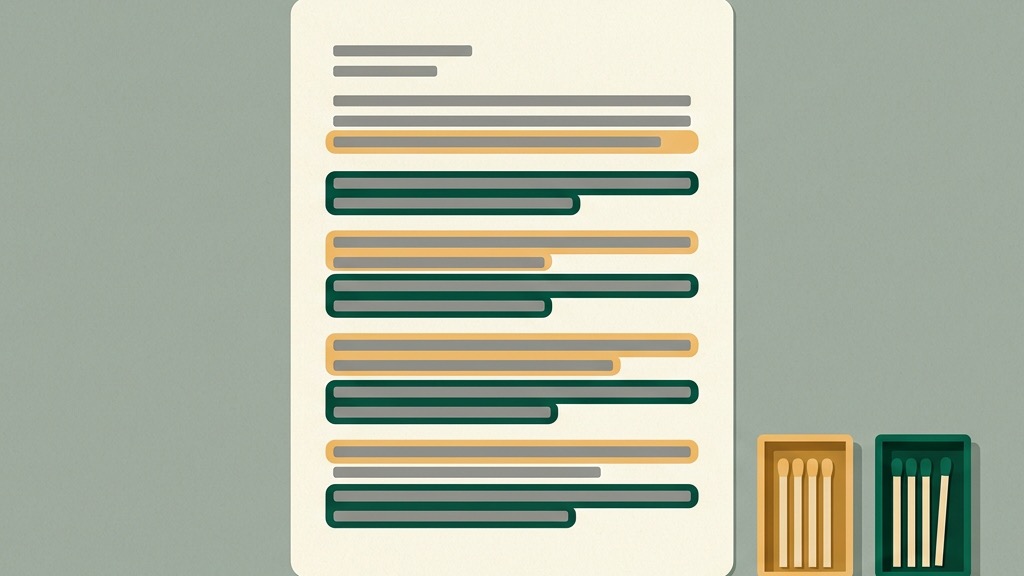
Open the report and put every match into one of two piles. Harmless: quotation you attributed, bibliography entries, boilerplate phrases, the assignment question itself if it was pasted in. Real: runs of matched words inside passages you are presenting as your own writing.
The piles get different treatment. Harmless matches are a filtering and formatting problem, handled below, and rewriting them is wasted effort that often makes the paper worse. Real matches are a writing problem, and no filter should ever be pointed at them.
Citation matches deserve one specific check while you sort: quotes lose their protection when the formatting breaks, which is why properly cited text still gets flagged more often than people expect. A block quote has no quotation marks by design, so a quote filter that keys on quotation marks sails right past it.
Rewrite the real matches from the notes, not from the screen
A flagged passage you rewrote by staring at it and swapping words will often match again on the next scan, because the sentence skeleton is still the source's. That loop, scan, tweak, rescan, is the single most common way students spend three hours lowering a score by four points.
Break the loop by closing the source. Read the flagged passage, read your source notes, then put both away and write what the passage needs to say from memory. The full method is the same one that produces a paraphrase that does not need rescuing, and it is faster than the tweak loop, not slower, because it converges in one pass.
Then keep the citation. A genuine paraphrase still credits the idea. Removing the citation to make the passage look independent converts a similarity problem into an integrity one.
Spend your quotations where they earn their length
Some papers score high for the dull reason that a third of the text is quotation. Every quoted word is a matched word, legitimately, and a reader can see the padding as clearly as the checker can.
The test for each quote: does the exact wording matter, or only the point? Keep the quote when the phrasing itself is the evidence, a definition you will analyze, a claim you will push against, a sentence too precise to improve. Everything else becomes a shorter paraphrase with the same citation. Cutting a 60-word quote to the 12 words you actually discuss lowers the score and sharpens the paragraph in the same motion.
The filters belong to your instructor, so have the conversation
Turnitin's own documentation on exclusions is clear about who holds the controls. Instructors set whether quotes, bibliographies, and small matches are excluded from scoring, and can set a minimum match length below which nothing counts. Anything you exclude from your own student view is temporary and does not change the official score your instructor sees.
That asymmetry is worth acting on rather than resenting. If your score is inflated by quotes and references, the fix is one specific, unembarrassing email: "My similarity score includes my quotations and bibliography. Could you tell me whether the assignment excludes those, so I know how to read my number?" Instructors answer that question happily, because it is the question of someone trying to read the report correctly rather than beat it.
What you learn usually reframes the whole problem. A 28% with quotes and bibliography included can be a 12% underneath, and knowing that before you start rewriting saves you from sanding down perfectly good citations.
If the biggest match is your own earlier draft
A special case that produces some of the highest and most frightening scores: the top match is you. If you submitted a draft to an assignment that stores papers in Turnitin's repository, your final version can come back matching that draft almost in full, and the report treats it like any other source.
Do not start rewriting your own paper to dodge your own paper. This is entirely an administrative fix. Tell your instructor the top match is your earlier draft for the same work; they can exclude the match from the report or, for future drafts, use the no-repository setting that exists for exactly this. Which repository a submission lands in is an assignment setting you cannot see from the student side, so the email is the only reliable way to sort it out.
The prevention version of this fix is asking one question before you ever upload a practice run: does this draft submission get stored?
Know why the shortcuts fail, so you can stop being tempted
It helps to see the failure modes plainly. Character substitution is reversed before scanning, so it does not even move the number, and the red flag it leaves behind is worse than any score. Hidden white text is flagged the same way. Synonym-spinning tools produce text that trips paraphrase detection while reading like a thesaurus fell down the stairs, which your instructor notices before any software does.
The common thread is that every shortcut leaves the structure of the borrowed text intact and adds evidence of concealment on top. A flagged trick converts "this student paraphrases too close to the source" into "this student tried to deceive the checker," and those two sentences have very different meetings attached.
Rescan, then stop
After the real matches are rewritten and the quotes are trimmed, scan once more and read the result by match type rather than by the headline number. PlagiarismCheck.io is free for this, needs no account, and its ignore-quotes and ignore-bibliography settings let you preview roughly what your text looks like with the harmless piles filtered out, the way your instructor's configured report might treat them. The 2,000-word cap means a long paper goes through in sections.
One honest caveat: no external scan reproduces Turnitin's exact number, because no other tool searches its student paper repository. What a pre-submission scan shows you is whether your own writing still leans on its sources' wording, and that is the thing you can actually fix.
The whole sequence, in the order that wastes the least effort:
- Sort every match into harmless or real before editing anything
- Ask your instructor which exclusions the assignment applies, and flag any own-draft match
- Rewrite real matches closed-book, keeping their citations
- Cut each quotation to the words you actually discuss
- Rescan, read by match type, and stop
Then submit. A similarity score is a description of how you wrote, not a grade to be optimized past the point where the writing stops improving. Fix the real matches, read the rest correctly, and the number takes care of itself.